



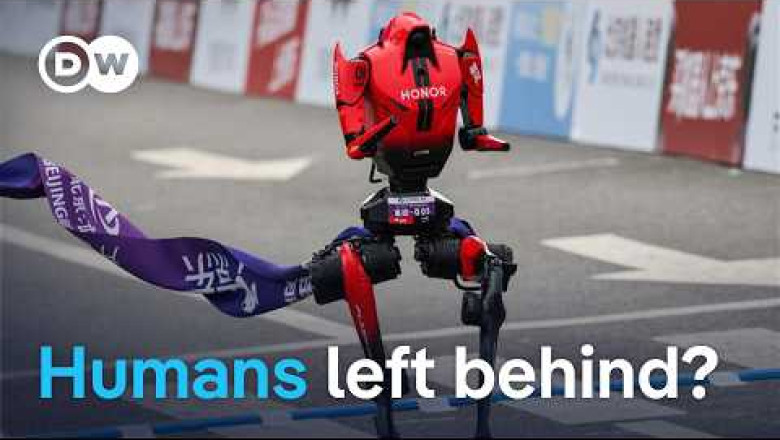

Beijing's half-marathon featured humanoid robots racing humans in separate lanes for safety. "Lightning", the winning robot, delivered a record-breaking performance. DW spoke with Ravinder Dahiya, Northeastern University professor and robotic touch-sensing specialist, on the tech advancing robot mobility and real-world endurance.
In a groundbreaking display of technological prowess, humanoid robots have shattered human running records at the 2026 Beijing E-Town Half Marathon, marking a pivotal moment in the evolution of robotics and artificial intelligence.
Lightning Strikes Gold
The star of the show was "Lightning," a humanoid robot developed by Chinese company Honor (Shenzhen Honor Smart Technology Development Co., Ltd.), which completed the 21-kilometer race in an astonishing 50 minutes and 26 seconds.
A Race Like No Other
The event, held in Beijing's Economic-Technological Development Area (E-Town), featured an unprecedented 300+ humanoid robots competing alongside approximately 12,000 human runners.
To ensure safety and prevent collisions, robots and humans ran on parallel tracks separated by guardrail fences, following the same 21km route.
The race, which ran from 7:30 to 10:40 AM, showcased robots operating in both autonomous and remote-controlled modes.
Behind the Scenes: Robot Pit Stops
Unlike human runners who hydrate and refuel at aid stations, the humanoid competitors required a different kind of support. Specialized resupply stations were set up along the course where technicians performed rapid battery swaps and cooling procedures to keep the robots operating at peak performance.
These technical interventions were crucial, as maintaining optimal temperature and power levels proved essential for sustaining the robots' speed and stability throughout the grueling 21-kilometer distance.
Expert Perspective
DW News spoke with Ravinder Dahiya, professor of electrical and computer engineering at Northeastern University in Boston and a specialist in robotic touch sensing, about the implications of this achievement.
According to Professor Dahiya, this milestone represents far more than just a novelty race. "What we're witnessing is the rapid maturation of bipedal locomotion, balance control, and energy efficiency in humanoid robots," he explained. "These systems are transitioning from laboratory demonstrations to real-world applications".
The professor emphasized that the endurance and stability required to complete a half-marathon demonstrate significant advances in several critical areas: dynamic balance on varied terrain, power management, thermal regulation, and autonomous decision-making.
The Competition
While Lightning stole the headlines, other notable competitors included the "Tiangong Ultra," a 5'9" robot weighing 114.6 pounds, which finished in 2 hours and 40 minutes.
The event served as the world's second humanoid robot half-marathon, building on lessons learned from previous test runs and competitions.
What This Means for the Future
The implications of this achievement extend far beyond the racetrack. The technologies demonstrated—efficient bipedal locomotion, endurance, autonomous navigation, and real-time adaptation—have direct applications in:
- Search and rescue operations in disaster zones
- Elderly care and assistance in homes and facilities
- Industrial and warehouse automation
- Space exploration on uneven terrain
- Military and security applications
Professor Dahiya noted, "The ability to maintain stable, efficient movement over extended periods while adapting to environmental changes is exactly what's needed for robots to operate effectively in human environments."
China's Robotics Ambitions
The event underscores China's aggressive push to become a global leader in humanoid robotics. Beijing's E-Town, officially known as the Beijing Economic-Technological Development Area, has positioned itself as a hub for robotics innovation and testing.
By hosting such high-profile demonstrations, China is not only showcasing its technological capabilities but also accelerating development through real-world testing scenarios that push the limits of current robotics technology.
The Human Element
Despite the robots' superior performance, the approximately 12,000 human participants weren't overshadowed. Many runners embraced the unique opportunity to share the course with cutting-edge robotics, creating a surreal scene where flesh-and-blood athletes ran alongside their mechanical counterparts.
For most human runners, the separate lanes meant they rarely interacted directly with the robots during the race, but the knowledge that they were participating in a historic event added extra motivation.
Technical Challenges Overcome
Completing a half-marathon presents unique challenges for humanoid robots that don't exist in controlled laboratory environments:
- Variable terrain: Even well-maintained roads have slight irregularities
- Temperature management: Sustained physical activity generates heat
- Power efficiency: Balancing speed with battery consumption
- Balance and stability: Maintaining upright posture for extended periods
- Autonomous navigation: Following the correct route without human intervention
Lightning's sub-51-minute completion time demonstrates that engineers are making rapid progress in solving these complex challenges.
Looking Ahead
As robotics technology continues to advance at breakneck speed, events like the Beijing E-Town Half Marathon serve as important benchmarks. They provide measurable, comparable data on robot performance in real-world conditions.
Professor Dahiya predicts that we'll see even more impressive performances in future competitions. "We're likely looking at continued improvements in battery technology, more efficient actuators, and better AI for real-time decision-making. The robots of tomorrow will be faster, more efficient, and more capable than we can imagine today".
The question is no longer whether robots can match human physical performance—in some domains, they already have. The focus now shifts to how we integrate these increasingly capable machines into our society, economy, and daily lives.
As the dust settles on Beijing's historic race, one thing is clear: the age of practical, mobile humanoid robots isn't coming—it's already here.
This event represents a significant milestone in robotics development, demonstrating that humanoid robots can now perform sustained physical tasks in uncontrolled environments. As the technology matures, the applications will extend far beyond the racetrack, potentially transforming industries and daily life in ways we're only beginning to understand.
China: Humanoid robots leave humans behind on the racetrack | DW News




















Comments
0 comment